
Combine Infrared Saunas & Red Light Therapy to Optimize Your Health Routine
November 1, 2024
Written By: Dr. Raleigh Duncan
Many wellness enthusiasts have wondered, “Can I use red light therapy and infrared saunas together?” While some sources claim these therapies shouldn’t or can’t be combined, the truth is that using red light therapy with your infrared sauna can amplify their benefits. Individually, each therapy offers powerful health advantages, but when used in tandem, they work synergistically to maximize healing, detoxification, and relaxation.
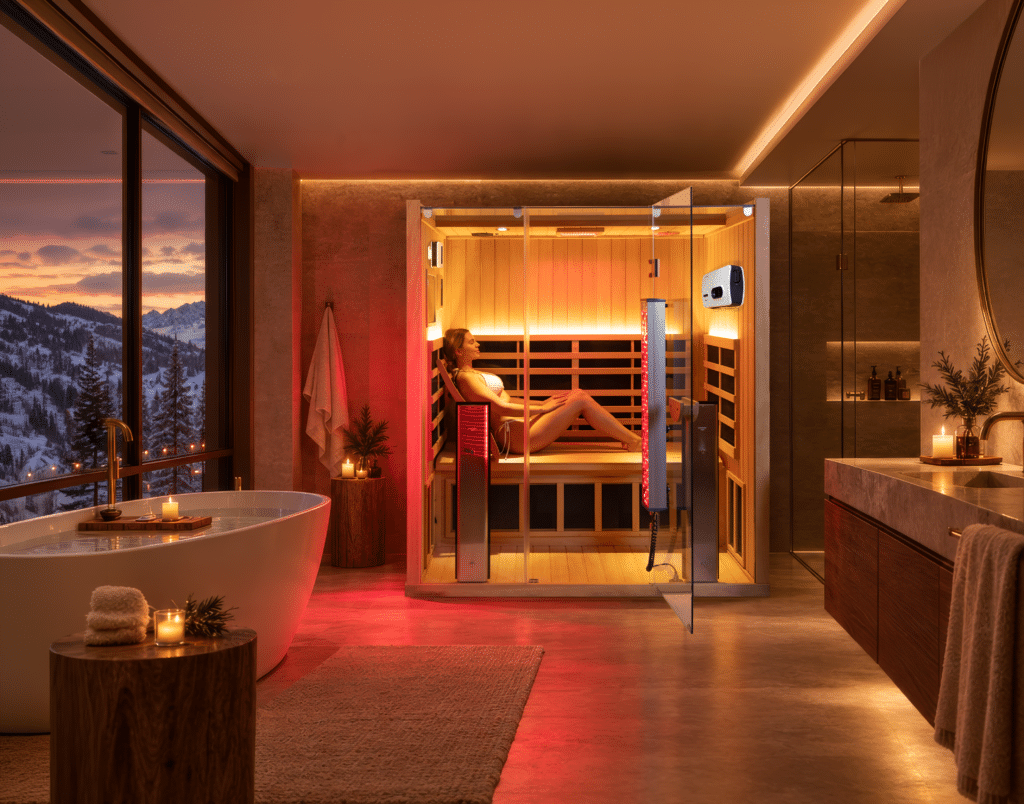
An infrared sauna with red light therapy pairs two therapies that work through different pathways in the same 20-minute session. Infrared heat raises your core temperature, drives circulation and triggers a heat-stress response your body adapts to. Red and near-infrared light are absorbed by your cells and support the energy production that repair depends on. You can run both at once, and this guide covers how to do it: what the combination does, when to use each therapy, what wavelengths and distances matter, and what the research supports.
Can You Use Red Light Therapy in an Infrared Sauna?
Yes. Red light therapy and infrared sauna heat can be used in the same session, and there is no physiological reason to keep them apart for most healthy adults. They act on the body through separate mechanisms, so running them together does not cancel either one out.
When the infrared sauna heats your body, vasodilation naturally occurs. The heat and increased blood flow helps us to detox, relax, and recover from stress and muscular pain. We start to feel better as the infrared heat releases endorphins, serotonin, and dopamine, and soon our immune system releases more white blood cells to fight off infections.
Later on in the process, there is a general release of HSPs, or heat shock proteins, that repair and replace old proteins. BDNF, or brain-derived neurotrophic factors, are released during infrared sauna usage and play an important role in creating new cells in the brain and enhancing overall brain function.
Clearlight: The Original Red Light Infrared Sauna™
For nearly 30 years, Clearlight has pioneered infrared wellness for the home. In 2019, we became the first infrared sauna company to bring red light therapy directly into the sauna environment, making it easy to experience both therapies together.
Effective red light therapy requires attention to wavelengths, dose, optics, distance, and placement. That’s why we engineered a purpose-built device for the sauna. Our CORE Tower mounts on the sauna door, directing light toward your body without fabric covering the LEDs, as some other brands have. This means it is designed for the sauna’s heated environment, and it uses patented Variable Optics™ technology to combine concentrated, targeted light with broader coverage than most of the red light products on the market.
Our patented Variable Optics™ Red Light Therapy towers can be used inside or outside the Sauna. Pair the CORE Tower with a compatible Clearlight sauna or use it on its own, and explore the PERSONAL or FULL BODY Towers for standalone sessions tailored to your needs. With mounting and stand options across the range, it’s easy to build a setup that fits your space and daily routine.
Clearlight’s red light units use powerful red light and near infrared to heal the body while reducing inflammation and adding energy into the mitochondria of cells by stimulating the production of ATP in a process called photobiomodulation. This groundbreaking process and red light therapy in general has been heavily researched and its effectiveness proven many times over.
Red light therapy becomes a useful addition when used in the sauna by increasing the lifespan of the cells involved in the healing process. In other words, red light therapy enhances and prolongs the effectiveness of the infrared sauna by increasing the actions of infrared healing and allowing them to last longer and go deeper!

Do Infrared Saunas Have Red Light Therapy?
Some do and most do not. Red light therapy is usually an add-on rather than a standard feature, and the term gets used loosely, so it is worth knowing what you are looking at:
- Integrated red light panels or towers. Purpose-built LED arrays delivering specified red and near-infrared wavelengths at a stated output. This is red light therapy.
- Near-infrared heaters. Part of a full-spectrum sauna’s heating system. Near-infrared overlaps with the therapeutic range, but heaters are built to produce heat, not a controlled light dose.
- Chromotherapy or color lighting. Colored LEDs for ambiance or chromotherapy. Not red light therapy, whatever the color.
- Red-tinted cabin lighting. Decorative only.
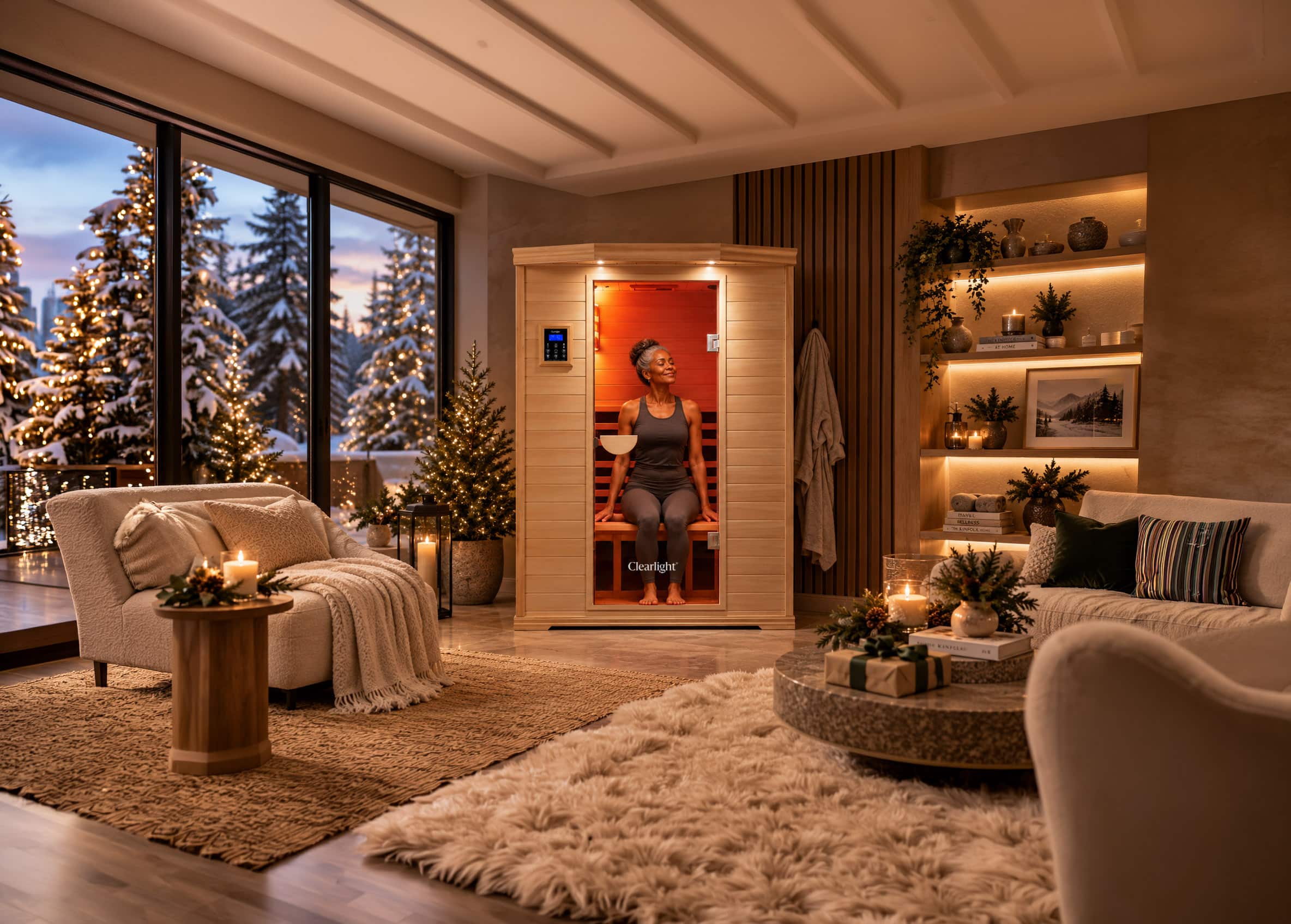
Clearlight saunas are compatible with the CORE Red Light Tower, which mounts to the sauna door or wall and can also be used as a standalone unit outside the cabin.
Is an Infrared Sauna the Same as Red Light Therapy?
No. Both use light from the infrared and red light part of the spectrum, but they are doing different jobs. An infrared sauna uses far-infrared, and to a lesser degree mid- and near-infrared, to heat your body from the inside out; the therapeutic effect comes from the heat. Red light therapy uses visible red and near-infrared light that your cells absorb directly; the therapeutic effect comes from the light itself, and it produces very little warmth.
The short version: a sauna heats you, red light therapy does not. For a full side-by-side, see our guide to infrared therapy vs. red light therapy.
Myth-Busting: Red Light Therapy and Infrared Saunas
Some sources suggest that red light therapy (RLT) and infrared saunas should not be used together, but this claim is often based on misconceptions rather than science. One common myth is that the overlapping wavelengths of red and infrared light might cancel each other out or that using both might overstimulate the body. However, these therapies are not only compatible, but can work in harmony for an enhanced therapeutic effect.
Together, they create a multi-level healing effect: while infrared heat relaxes muscles and improves circulation, red light adds energy directly to the cells, promoting faster recovery and deeper rejuvenation. So, despite what some may say, combining RLT and infrared heat is both safe and highly beneficial for overall wellness.

Benefits of an Infrared Sauna with Red Light Therapy
Each therapy has its own evidence base, and they overlap in useful ways. Below is what the combination is used for and how well supported each use is, so you can set expectations honestly.
Muscle recovery and soreness. The best-supported reason to stack these. Sauna heat increases blood flow to working muscle, and red and near-infrared light applied around training has been studied for reduced soreness and faster return of strength. If you train hard, this is the benefit to build your routine around.
Skin health and collagen. Red light in the 630 to 660 nanometer range is the most studied wavelength band for skin, with research on collagen production, fine lines and wound healing. Sauna heat increases circulation to the skin at the same time. Expect gradual change over weeks, not days.
Pain and stiffness. Heat is a long-standing approach to joint and muscle stiffness, and photobiomodulation has been studied for musculoskeletal pain. Many people find the combination more useful than either therapy alone, though direct research on the pairing is limited.
Sleep and relaxation. A sauna session lowers stress and the drop in core temperature afterward is associated with easier sleep onset. Red light does not carry the circadian disruption that blue light does, so an evening session is a reasonable habit. This benefit is widely reported and lightly studied.
Circulation and cardiovascular health. Regular sauna bathing has the strongest long-term evidence, including a 20-year Finnish cohort study linking frequent sauna use to lower cardiovascular mortality. That evidence is about the sauna, not the light.
Mood and mental clarity. Both therapies are studied for mood, and most people notice the session itself is restorative. Treat this as a real but subjective benefit.
How to Combine Infrared Sauna and Red Light Therapy: A Step-by-Step Protocol
Here is a routine you can start with and adjust. It assumes a red light tower mounted inside or at the door of your sauna.
Hydrate first. Drink 16 to 20 ounces of water in the half hour before you start. You will sweat more than you expect.
Preheat the cabin. Give the sauna 15 to 20 minutes to reach your target temperature, typically 120°F to 140°F for a full-spectrum infrared cabin.
Start the light with the session. Turn the tower on as you sit down. Skin should be bare and facing the panel, since clothing blocks the wavelengths that matter.
Run the light for 10 to 20 minutes. Ten to 20 minutes standing or seated close to the tower, or 20 to 30 minutes seated further back on the bench. Reposition partway through if you want to treat more than one area.
Finish the sauna session. Total sauna time of 20 to 40 minutes, with the light on for part or all of it. There is no benefit to running the light for the entire session if it is longer than 30 minutes.
Cool down and rehydrate. Five to 10 minutes of cooling before a shower, and replace the fluid you lost.
Repeat three to four times a week. Consistency matters more than session length for both therapies. Three shorter sessions beat one long one.
Red Light Therapy Before, During or After Your Sauna
All three work. Which one to pick depends on your setup and what you are after.
During the session is the most practical, and what we recommend for most people. One habit instead of two, and the heat has already increased blood flow to the tissue the light is reaching. This is what the CORE Tower is designed for and why Clearlight leads the way in therapy stacking.
After the sauna suits a recovery focus. Heat is a stressor your body adapts to, and some people prefer to apply red light during the recovery window that follows. If you do this, cool down for five to 10 minutes first so you are not adding light exposure on top of peak heat load.
Before the sauna suits a skin focus. Clean, dry, cool skin absorbs light without a layer of sweat in the way.
If you find heat and light together uncomfortable, or you are new to either therapy, separate them and build up. There is no penalty for doing them in sequence.
Setup & Dosage Specs
| Face and skin | Joints and muscle | Full body | |
|---|---|---|---|
| Distance from panel | 4 to 6 inches | 6 to 18 inches | 12 to 18 inches |
| Session length | 10 to 20 minutes | 10 to 20 minutes | 20 to 30 minutes |
| Wavelengths that matter | 630 to 660 nm (red) | 810 to 850 nm (near-infrared) | Both bands |
| Position in the cabin | Seated, facing the tower | Target area toward the panel | Standing or reclined |
| Frequency | 3 to 4 times a week | 3 to 4 times a week | 3 to 4 times a week |
Choosing the Best Red Light & Infrared Sauna
To get the most out of combining red light therapy and infrared saunas, it’s essential to choose the right equipment designed for compatibility. With the right tools, you can create an effective, home-based healing environment that leverages the best of both red light therapy and infrared heat. Make sure to invest in high-quality equipment that suits your specific health goals for an optimal, synergistic experience. Here’s what to look for:
Red Light Therapy Wavelengths
For red light therapy, ensure that your device uses wavelengths within the optimal range, typically around 630-660 nm for red light and 800-850 nm for near-infrared. These wavelengths are proven to be effective for cellular regeneration and inflammation reduction, offering maximum benefits when paired with infrared sauna therapy.
Integrated with Infrared Saunas vs. Standalone Units
Some saunas come with built-in red light therapy panels, which can be convenient and space-saving. However, standalone red light devices allow for greater flexibility, enabling you to focus the light on specific body areas if needed, whether you’re aiming for full-body effects or targeted healing. The CORE Red Light Tower by Clearlight is the best of both worlds; easily installed on the door of your infrared sauna, or paired with a floor stand for use anywhere in your home.
Types of Infrared Saunas
Not all infrared saunas are created equal. To complement your red light therapy routine, look for a full-spectrum sauna that delivers near-, mid-, and far-infrared wavelengths, each penetrating the body at a different depth. Pairing full-spectrum infrared heat with red light therapy creates a more well-rounded detox and relaxation experience while supporting the benefits of both.
Red Light Therapy Sauna at Home
A red light therapy sauna at home removes the one thing that actually derails results: getting there. Both therapies are cumulative rather than immediate, so three short sessions a week in your own space will do more than the occasional studio visit you have to book and drive to. Owning the setup also means the session bends to your schedule, 10 minutes or 30, first thing in the morning or right before bed.
Research and Safety Evidence
Both therapies have a real research base. The pairing of the two has almost none, and it is worth being straightforward about that.
On saunas. A 2018 systematic review of regular dry sauna bathing found consistent evidence for cardiovascular and pain outcomes alongside a good safety profile. A 20-year prospective study of 2,315 Finnish men reported that men using a sauna four to seven times a week had substantially lower cardiovascular and all-cause mortality than men using one once a week.
On red light therapy. Photobiomodulation is well characterized at the cellular level, with light absorbed in the mitochondria supporting ATP production. It has been studied specifically for skin, where red wavelengths are associated with collagen synthesis and wound healing, and for muscle performance and recovery.
On dose. The biphasic dose response is one of the better-established findings in the field. Too little light does nothing and too much reduces the benefit, which is why session length and distance are worth getting right.
On using them together. Direct clinical research on simultaneous use is essentially absent, and anyone who tells you otherwise is overstating it. What exists is mechanistic. A 2022 editorial in Photobiomodulation, Photomedicine, and Laser Surgery by Michael Hamblin, one of the field’s most cited researchers, proposes that infrared saunas and photobiomodulation may share a pathway through heat-sensitive TRP ion channels, and that devices designed to heat tissue could carry out some of the same biological mechanisms as devices that do not. That is a reason to think the two are compatible. It is not proof that the combination outperforms either therapy on its own.
1. Hamblin MR. Traditional or Infrared Saunas and Photobiomodulation: What Do They Have in Common? Photobiomodulation, Photomedicine, and Laser Surgery. 2022;40(9):595–596. doi:10.1089/photob.2022.0078
2. Hussain J, Cohen M. Clinical Effects of Regular Dry Sauna Bathing: A Systematic Review. Evidence-Based Complementary and Alternative Medicine. 2018;2018:1857413. doi:10.1155/2018/1857413
3. Laukkanen T, Khan H, Zaccardi F, Laukkanen JA. Association Between Sauna Bathing and Fatal Cardiovascular and All-Cause Mortality Events. JAMA Internal Medicine. 2015;175(4):542–548. doi:10.1001/jamainternmed.2014.8187
4. Huang YY, Sharma SK, Carroll J, Hamblin MR. Biphasic Dose Response in Low Level Light Therapy: An Update. Dose-Response. 2011;9(4):602–618. doi:10.2203/dose-response.11-009.Hamblin
5. de Freitas LF, Hamblin MR. Proposed Mechanisms of Photobiomodulation or Low-Level Light Therapy. IEEE Journal of Selected Topics in Quantum Electronics. 2016;22(3):7000417. doi:10.1109/JSTQE.2016.2561201
6. Avci P, Gupta A, Sadasivam M, et al. Low-level laser (light) therapy (LLLT) in skin: stimulating, healing, restoring. Seminars in Cutaneous Medicine and Surgery. 2013;32(1):41–52.
7. Ferraresi C, Huang YY, Hamblin MR. Photobiomodulation in human muscle tissue: an advantage in sports performance? Journal of Biophotonics. 2016;9(11–12):1273–1276. doi:10.1002/jbio.201600176
Infrared Therapy and RLT for Your Wellness Routine
Incorporating red light therapy into your infrared sauna routine can be a game-changer for your health journey. This combination not only supports relaxation and recovery but also aids in cellular regeneration and immune support, working to optimize your body’s healing process. Whether you’re looking to relieve stress, boost brain health, or support muscle recovery, red light therapy in an infrared sauna offers a powerful, natural approach to enhanced well-being. Embrace this dynamic duo and experience a deeper, more effective healing journey.
The reason to combine these therapies is not that either one is insufficient. It is that the version of a wellness routine you actually keep is the one that fits into a single 30-minute block.
Frequently Asked Questions
Should you do red light therapy before or after a sauna?
During the session is the most practical and what we recommend for most people. After suits a recovery focus, and before suits a skin focus. All three work.
How long should you use red light therapy in a sauna?
Ten to 20 minutes close to the tower, or 20 to 30 minutes seated further back. Longer is not better; red light follows a biphasic dose response.
Can I add red light therapy to my existing infrared sauna?
In most cases, yes. A mounted tower attaches to the door or wall and runs off a standard outlet. Check the clearances for your cabin model.