

Understanding the Wellness Light Spectrum: The Difference Between UVA, UVB, Red Light, Visible Light, and Infrared
August 4, 2026
From the warmth of the sun on your skin to the glow of an LED wellness device, light surrounds us every day. But not all light is the same.
Light is made up of a broad spectrum of wavelengths, each interacting with the body in different ways. Some wavelengths help regulate our sleep-wake cycle, others initiate the body’s natural production of vitamin D, while others are used in wellness technologies designed to support relaxation or normal cellular function.
Understanding these differences can help you make informed decisions about incorporating light-based wellness practices into your daily routine.
The Electromagnetic Spectrum at a Glance
The sun emits a broad range of electromagnetic energy, but only a portion reaches the Earth’s surface. The wavelengths most commonly associated with health and wellness include ultraviolet (UVA and UVB), visible light (including red light), and infrared light.
Although these forms of light all originate from the same source, each has unique characteristics and interacts with the body differently.
UVA Light (315–400 nm)
UVA makes up approximately 95% of the ultraviolet radiation that reaches the Earth’s surface.
Because it has a longer wavelength than UVB, UVA penetrates deeper into the skin and remains relatively constant throughout the day and year. Unlike UVB, UVA does not stimulate the body’s natural production of vitamin D.
UVA is a natural component of sunlight and is present even on cloudy days and through window glass.
UVB Light (290–320 nm)
UVB represents a much smaller portion of natural sunlight, yet it plays a unique biological role.
When UVB reaches exposed skin, it initiates the body’s natural production of vitamin D by converting a naturally occurring compound called 7-dehydrocholesterol into previtamin D₃, which is then converted into vitamin D₃.
The amount of UVB reaching the Earth’s surface varies considerably depending on:
- Time of day
- Season
- Latitude
- Elevation
- Cloud cover
- Air pollution
Unlike UVA, UVB does not pass through standard window glass, which is why sitting indoors near a sunny window does not support the body’s natural vitamin D production.
Visible Light (400–700 nm)
Visible light is the portion of the spectrum our eyes can detect. It includes all the colors of the rainbow and plays an essential role in daily life.
Exposure to natural daylight—particularly in the morning—helps regulate the body’s circadian rhythm, supporting healthy sleep-wake cycles, alertness, and overall well-being.
Different colors within the visible spectrum interact with the body in different ways, and researchers continue to study their influence on human physiology.
Red Light Therapy (Approximately 630–850 nm)
Red Light Therapy (RLT) uses specific wavelengths of visible red light (approximately 630–660 nm) and near-infrared light (approximately 810–850 nm). These wavelengths are different from ultraviolet light and far infrared heat, and they interact with the body through distinct biological pathways.
Unlike UVB, red light does not stimulate the body’s natural production of vitamin D and does not contain ultraviolet radiation.
Researchers continue to study how red and near-infrared light interact with mitochondria, the energy-producing structures within cells, through a process known as photobiomodulation. This growing field of research is exploring how specific wavelengths of light may support normal cellular energy production and healthy tissue function.
Because red light uses non-ionizing wavelengths within the visible and near-infrared spectrum, it provides an entirely different wellness experience than UVB or infrared heat.
Infrared Light
Infrared light begins just beyond the visible red portion of the spectrum and is experienced primarily as heat.
Infrared wellness technologies often utilize different portions of the infrared spectrum, with far infrared being commonly used in infrared saunas.
Unlike traditional saunas that primarily heat the surrounding air, far infrared energy gently warms the body through radiant heat, creating a comfortable wellness experience at lower ambient temperatures.
Importantly, infrared light does not stimulate vitamin D production because it operates through different biological mechanisms than UVB.
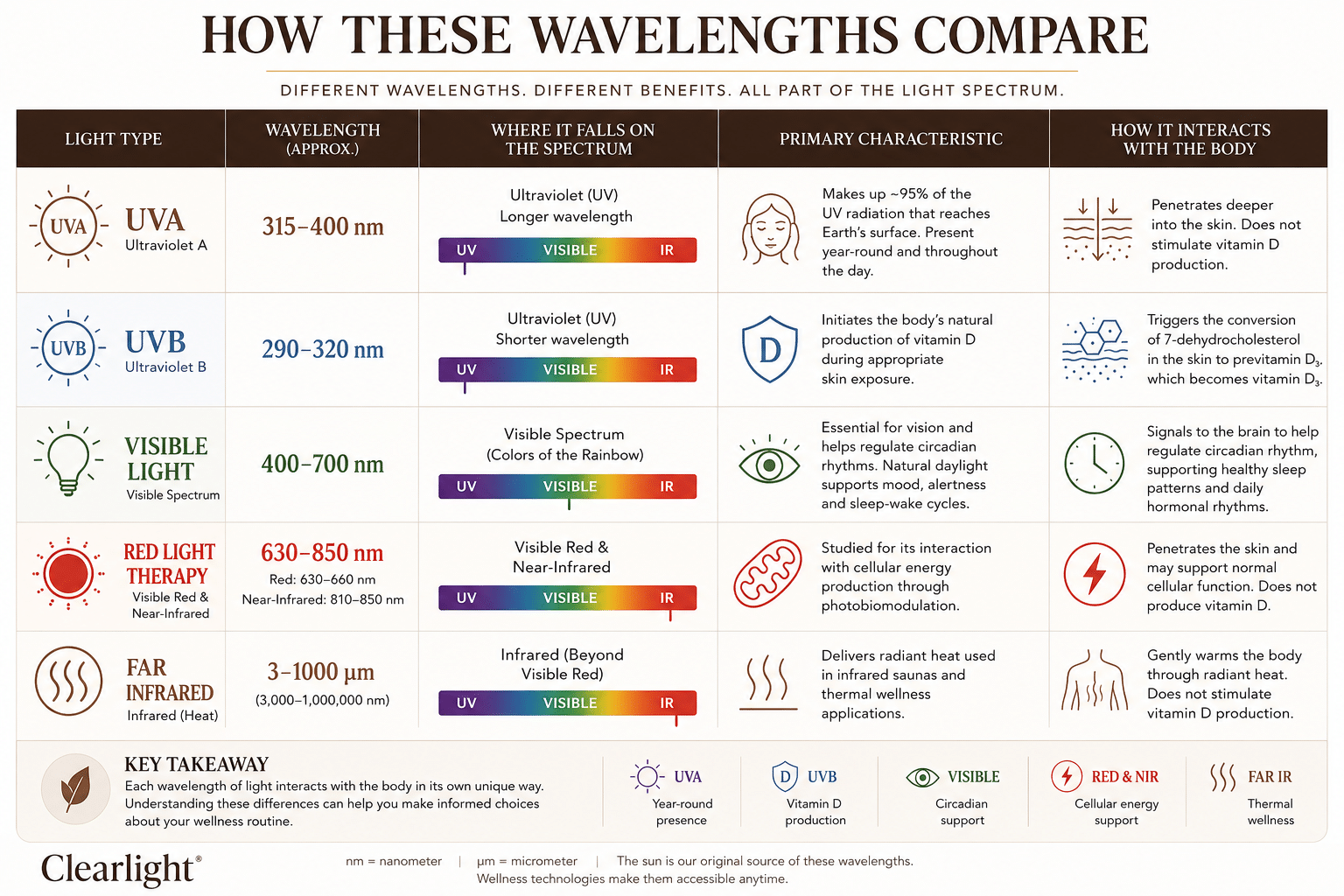
How These Wavelengths Compare
| Light Type | Wavelength | Primary Characteristic |
|---|---|---|
| UVA | 315–400 nm | Natural ultraviolet light present throughout the day; penetrates deeper into the skin. |
| UVB | 290–320 nm | Initiates the body’s natural production of vitamin D during appropriate skin exposure. |
| Visible Light | 400–700 nm | Supports vision and helps regulate circadian rhythms through natural daylight exposure. |
| Visible Red Light | 630–660 nm | Studied for its interaction with normal cellular energy production through photobiomodulation. |
| Near-Infrared Light | 810–850 nm | Often paired with red light in photobiomodulation devices due to its ability to penetrate deeper into tissue. |
| Far Infrared | Approximately 3–1000 μm | Provides radiant heat used in infrared saunas and other thermal wellness applications. |
Why Understanding the Light Spectrum Matters
Light is far more than illumination—it is an essential part of how we interact with our environment.
Each region of the light spectrum has unique characteristics:
- UVA is a natural component of sunlight and reaches the Earth year-round.
- UVB initiates the body’s natural production of vitamin D.
- Visible light helps regulate circadian rhythms and supports healthy daily biological cycles.
- Red and near-infrared light are being studied for their interaction with normal cellular energy production through photobiomodulation.
- Far infrared provides gentle radiant heat used in wellness practices such as infrared sauna bathing.
Rather than competing technologies, these wavelengths complement one another because each interacts with the body in different ways. Understanding the unique role of each can help individuals make informed choices about incorporating light-based wellness practices into a balanced, healthy lifestyle.
References
- National Institutes of Health, Office of Dietary Supplements. Vitamin D Fact Sheet for Health Professionals. https://ods.od.nih.gov/factsheets/VitaminD-HealthProfessional/
- World Health Organization. Ultraviolet Radiation Fact Sheet. https://www.who.int/news-room/fact-sheets/detail/ultraviolet-radiation
- International Commission on Illumination (CIE). Action Spectrum for the Production of Previtamin D₃ in Human Skin.
- Hamblin MR. Photobiomodulation or Low-Level Laser Therapy. Photochemistry and Photobiology.
- Anders JJ, Lanzafame RJ, Arany PR. Low-Level Light/Laser Therapy Versus Photobiomodulation Therapy. Photomedicine and Laser Surgery.